
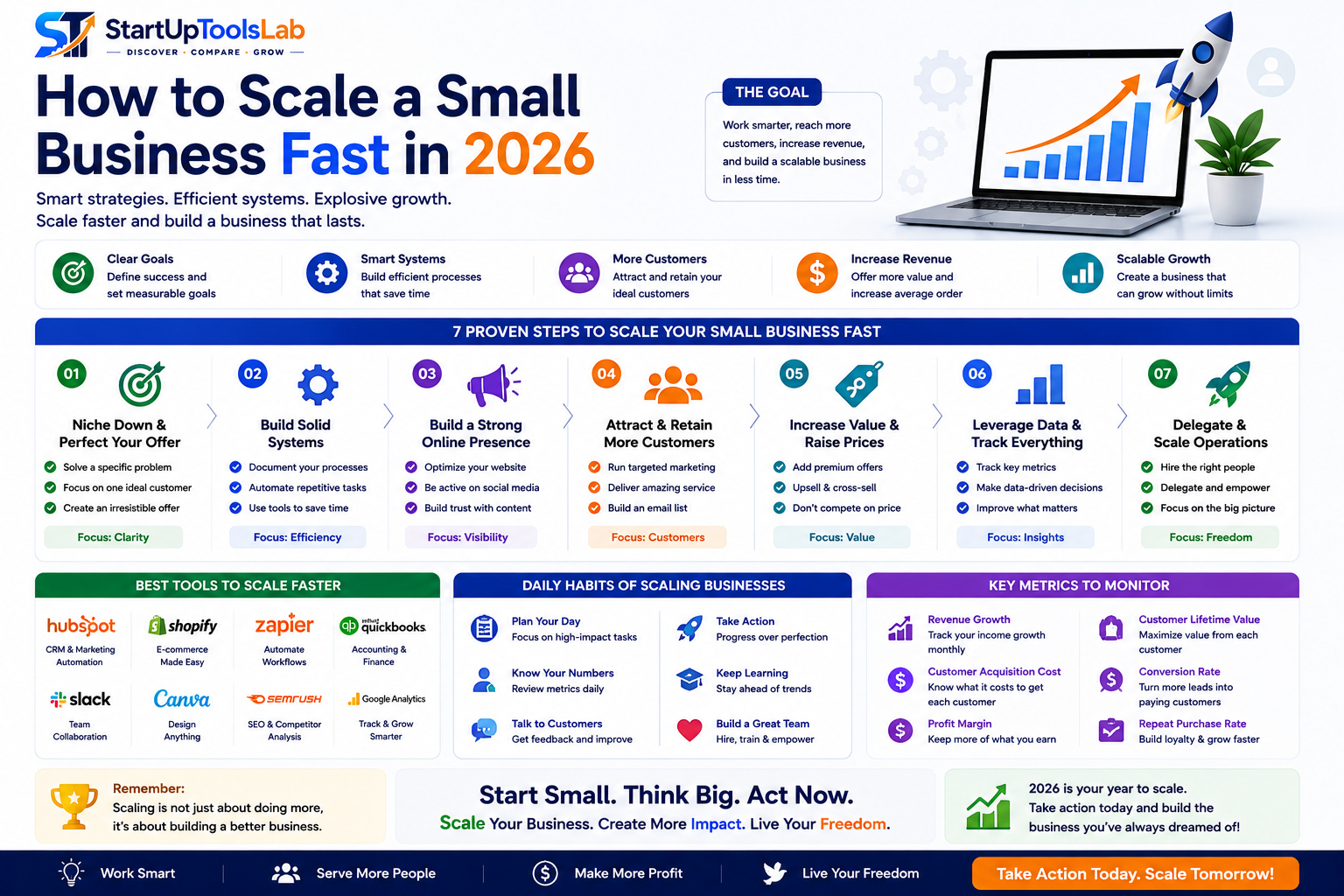
How to Scale a Small Business Fast in 2026
Starting a business is difficult. Scaling it successfully is an entirely different challenge.
Many small businesses reach a point where growth starts slowing down because operations become disorganized, marketing becomes inconsistent, customer demands increase, and founders get overwhelmed trying to manage everything manually.
The good news is that scaling a business in 2026 is much easier than it used to be.
Thanks to AI tools, automation software, cloud platforms, digital marketing systems, and remote collaboration tools, small businesses can now grow faster with smaller teams and lower operational costs.
But fast growth doesn’t happen randomly.
Businesses that scale successfully usually focus on:
- Systems
- Automation
- Marketing
- Customer retention
- Financial management
- Scalable operations
In this guide, we’ll cover practical strategies on how to scale a small business fast in 2026 without creating unnecessary chaos or burnout.
What Does Scaling a Business Actually Mean?
Many people confuse growth with scaling.
Business Growth
Growth usually means increasing revenue while also increasing costs at a similar rate.
Business Scaling
Scaling means increasing revenue much faster than expenses.
For example:
- A scalable business can serve more customers without needing to double the team size or workload immediately.
Scaling focuses on:
- Efficiency
- Automation
- Systems
- Long-term sustainability
Why Many Small Businesses Fail to Scale
Many businesses struggle because they try to grow without proper systems.
Common Scaling Problems
- Poor time management
- Weak marketing systems
- Inconsistent sales
- Manual operations
- Lack of automation
- Poor customer retention
- Hiring too late
- Financial mismanagement
Scaling successfully requires building systems before growth becomes overwhelming.
1. Build Systems Before You Scale
One of the biggest mistakes business owners make is trying to scale chaos.
If your operations are disorganized now, growth will only magnify the problems.
Important Systems Every Business Needs
- Customer management systems
- Project management workflows
- Marketing systems
- Financial tracking
- Communication processes
- Automation workflows
Helpful Productivity Tools
ClickUp
Helps businesses manage workflows, teams, projects, and automation.
Notion
Excellent for SOPs, documentation, and internal systems.
Asana
Useful for structured workflow management and team coordination.
Businesses with strong systems scale much faster and more efficiently.
2. Focus on One Strong Revenue Channel
Many small businesses grow slowly because they try too many strategies at once.
Instead of doing everything, focus on one proven customer acquisition channel first.
Examples of Strong Growth Channels
- SEO
- Paid ads
- Social media marketing
- Email marketing
- Affiliate marketing
- Influencer partnerships
- Content marketing
Mastering one channel often scales businesses faster than trying ten strategies poorly.
3. Invest in SEO for Long-Term Growth
SEO remains one of the most scalable marketing strategies in 2026.
Unlike paid ads, SEO generates long-term organic traffic without paying for every visitor.
Why SEO Helps Businesses Scale
- Lower customer acquisition costs
- Consistent traffic
- Long-term lead generation
- Brand authority growth
Best SEO Tools
Semrush
Keyword research, competitor analysis, and SEO audits.
Ahrefs
Backlink analysis and content research.
Surfer SEO
Helps optimize content for search rankings.
Businesses investing in SEO early often build stronger long-term growth engines.
4. Automate Repetitive Tasks
Automation is one of the fastest ways to scale efficiently.
If your business still depends heavily on manual work, growth will eventually become difficult.
Tasks Businesses Should Automate
- Email marketing
- Social media scheduling
- Customer onboarding
- Invoice reminders
- Lead nurturing
- CRM updates
- Reporting
Best Automation Tools
Zapier
Connects apps and automates workflows.
HubSpot
Automates marketing and customer management.
Mailchimp
Automates email campaigns and customer engagement.
Automation allows businesses to handle more customers without dramatically increasing workload.
5. Use AI Tools to Increase Productivity
AI is helping small businesses scale faster than ever before.
Modern AI tools improve:
- Content creation
- Customer support
- Marketing
- Analytics
- Workflow efficiency
Helpful AI Tools for Businesses
OpenAI ChatGPT
Helps businesses with:
- Content writing
- Marketing ideas
- Customer communication
- Workflow assistance
- Brainstorming
Canva
Uses AI-powered tools for content creation and design automation.
Businesses leveraging AI strategically save time while increasing output significantly.
6. Improve Customer Retention
Many businesses focus only on acquiring new customers while ignoring existing ones.
But retaining customers is usually much cheaper than constantly finding new ones.
Ways to Improve Customer Retention
- Better customer support
- Personalized communication
- Loyalty programs
- Email marketing
- Faster response times
- Consistent quality
Helpful Customer Tools
HubSpot
Zendesk
Intercom
Strong customer relationships create predictable business growth.
7. Build a Strong Brand
Businesses scale faster when customers trust and recognize them.
Strong branding improves:
- Customer loyalty
- Conversion rates
- Marketing performance
- Premium pricing opportunities
Important Branding Elements
- Professional website
- Consistent visuals
- Clear messaging
- Strong customer experience
- Social proof
Helpful Branding Tools
Canva
Simplifies professional branding and marketing design.
8. Hire Strategically, Not Emotionally
Many businesses either hire too late or hire too quickly.
Scaling requires smart hiring decisions.
First Roles Small Businesses Often Need
- Virtual assistants
- Customer support
- Sales representatives
- Content creators
- Marketing specialists
Instead of hiring large teams immediately, focus on roles that remove bottlenecks and increase efficiency.
9. Track Your Numbers Closely
Scaling without financial visibility is risky.
Businesses need to monitor:
- Revenue growth
- Profit margins
- Customer acquisition costs
- Cash flow
- Marketing ROI
- Retention rates
Best Financial Tools
QuickBooks
Xero
Wave
Businesses that understand their numbers make better growth decisions.
10. Create Scalable Offers
Some businesses struggle because their offers are too customized or time-intensive.
Scalable businesses usually create:
- Digital products
- Online courses
- Memberships
- Subscription services
- Productized services
- Automated solutions
Scalable offers reduce dependency on constant manual work.
Common Mistakes Businesses Make While Scaling
Many businesses damage growth by scaling too aggressively.
Common Mistakes Include:
- Growing without systems
- Ignoring cash flow
- Overspending on tools
- Hiring too quickly
- Weak customer support
- Poor delegation
- Trying to scale everything simultaneously
Fast scaling works best when operations remain organized and sustainable.
Future of Business Scaling in 2026
Modern businesses are scaling faster through:
- AI automation
- Remote teams
- SaaS platforms
- Cloud-based systems
- Content marketing
- E-commerce automation
- Subscription business models
Businesses that embrace automation and digital systems early have major competitive advantages.
Final Thoughts
Scaling a small business fast isn’t just about working harder — it’s about building smarter systems.
The businesses growing fastest in 2026 are leveraging:
- Automation
- AI tools
- SEO
- Digital marketing
- Customer retention
- Scalable workflows
The key is creating systems that allow your business to grow without overwhelming your team, finances, or operations.
Whether you’re running a startup, agency, ecommerce brand, SaaS company, or freelance business, focusing on systems, efficiency, and long-term scalability will help you grow faster and more sustainably.