
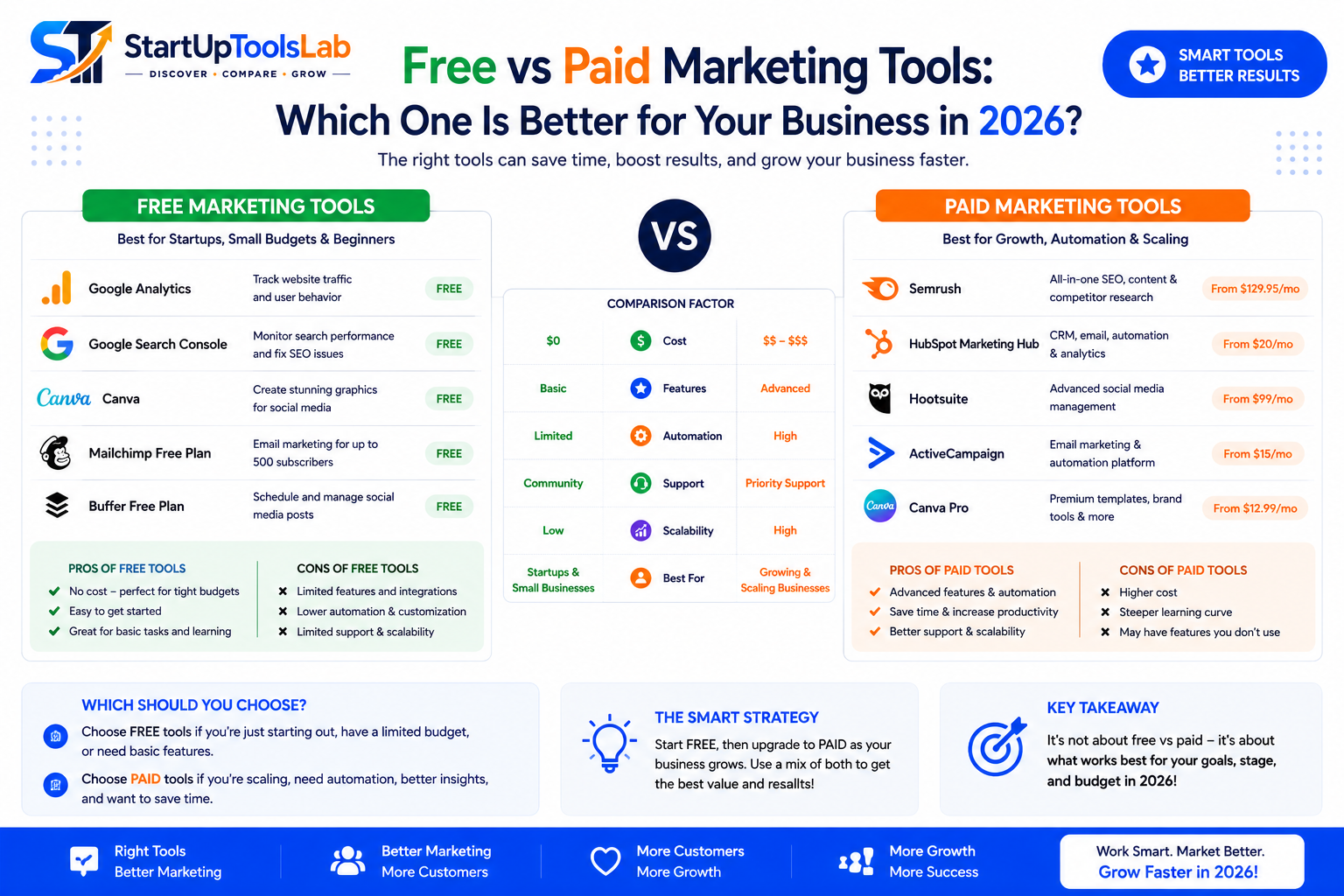
Free vs Paid Marketing Tools: Which One Is Better for Your Business in 2026?
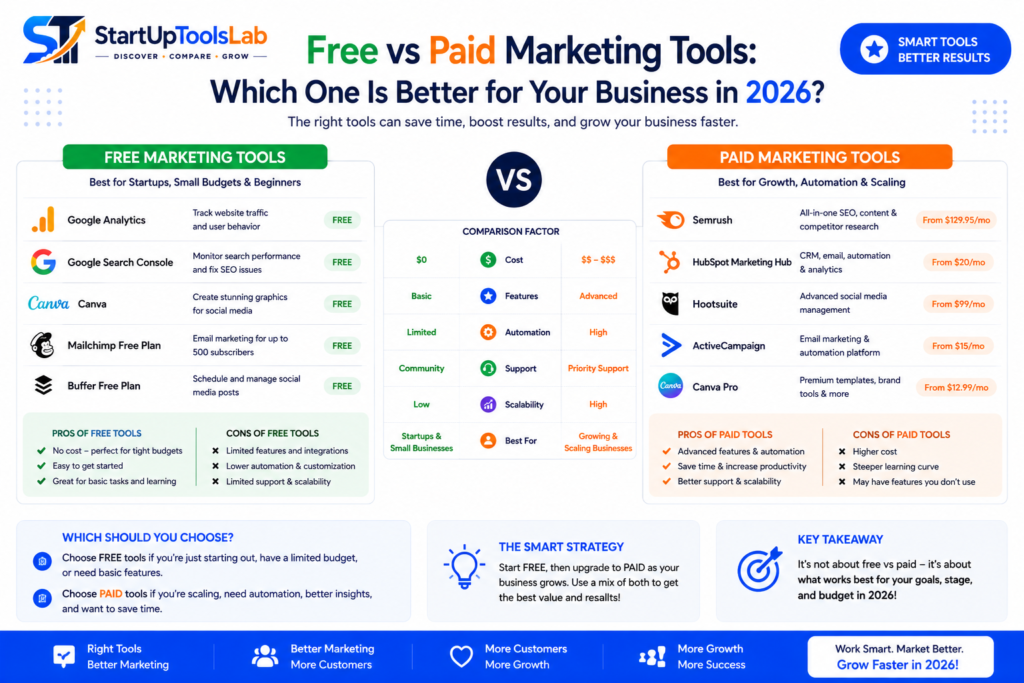
Marketing has become one of the biggest growth drivers for modern businesses. Whether you’re running a startup, an e-commerce store, an agency, a personal brand, or a small business, the tools you use can directly impact your productivity, lead generation, customer engagement, and sales.
But one major question every business faces is:
Should you use free marketing tools or invest in paid ones?
The answer depends on your business size, goals, budget, and growth stage.
In 2026, free marketing tools have become more powerful than ever. Many startups successfully run entire marketing operations using free software during their early stages. On the other hand, paid marketing tools offer advanced automation, analytics, scalability, and integrations that become essential as businesses grow.
In this guide, we’ll compare free vs paid marketing tools, explore their pros and cons, and help you decide which option is best for your business.
What Are Marketing Tools?
Marketing tools are software platforms that help businesses manage and improve their marketing efforts.
These tools are commonly used for:
- Email marketing
- SEO
- Social media management
- Content creation
- Automation
- Analytics
- Advertising
- Customer relationship management (CRM)
Modern SaaS marketing tools help businesses automate repetitive tasks, improve productivity, and scale faster.
What Are Free Marketing Tools?
Free marketing tools are platforms that offer essential features at no cost.
Many companies provide free plans to help businesses:
- Get started easily
- Test software before upgrading
- Build small-scale marketing systems
Examples of Popular Free Marketing Tools
Canva
Offers free graphic design tools for social media, presentations, and branding.
Mailchimp
Provides limited free email marketing features for startups and small businesses.
Google Analytics
Completely free website analytics and traffic tracking.
Google Search Console
Free SEO monitoring directly from Google.
Buffer
Offers limited free social media scheduling tools.
What Are Paid Marketing Tools?
Paid marketing tools offer advanced features, automation, deeper analytics, scalability, and professional-level capabilities.
These tools are usually subscription-based and designed for businesses that need:
- Larger marketing campaigns
- Team collaboration
- Advanced automation
- Detailed reporting
- Better scalability
Examples of Popular Paid Marketing Tools
Semrush
Advanced SEO, keyword research, and competitor analysis.
HubSpot
Comprehensive CRM and marketing automation platform.
ActiveCampaign
Advanced email automation and customer journey management.
Hootsuite
Professional social media scheduling and analytics.
Ahrefs
Powerful backlink analysis and SEO research platform.
Free Marketing Tools: Advantages and Disadvantages
Advantages of Free Marketing Tools
1. Cost Savings
The biggest advantage is obvious — they’re free.
This is extremely valuable for:
- Startups
- Freelancers
- Solo entrepreneurs
- Small businesses with limited budgets
2. Beginner-Friendly
Many free tools are designed to be simple and easy to use.
3. Great for Learning
Free tools allow beginners to learn marketing without financial risk.
4. Easy Testing
Businesses can test platforms before upgrading to premium plans.
Disadvantages of Free Marketing Tools
1. Limited Features
Most free plans restrict:
- Automation
- Analytics
- Team collaboration
- Storage
- Campaign limits
2. Branding Restrictions
Some platforms display their own branding on your campaigns or content.
3. Scalability Problems
As businesses grow, free plans often become too limiting.
4. Limited Support
Free users usually receive slower or minimal customer support.
Paid Marketing Tools: Advantages and Disadvantages
Advantages of Paid Marketing Tools
1. Advanced Automation
Paid platforms provide:
- AI-powered workflows
- Behavioral targeting
- Advanced email automation
- Smart segmentation
2. Better Analytics
Businesses gain deeper insights into customer behavior and campaign performance.
3. Scalability
Paid tools support larger teams, audiences, and campaigns.
4. Team Collaboration
Advanced workflows and permission systems improve operational efficiency.
5. Integrations
Premium tools connect more effectively with CRMs, websites, ecommerce platforms, and advertising systems.
Disadvantages of Paid Marketing Tools
1. Higher Costs
Monthly subscriptions can become expensive, especially for startups.
2. Learning Curve
Advanced tools often require training and onboarding.
3. Overwhelming Features
Small businesses sometimes pay for features they never actually use.
Free vs Paid Marketing Tools: Key Comparisons
| Feature | Free Tools | Paid Tools |
| Cost | Free or limited | Monthly subscription |
| Automation | Basic | Advanced |
| Analytics | Limited | Detailed reporting |
| Scalability | Small businesses | Growing businesses |
| Team Features | Limited | Full collaboration |
| Customer Support | Basic | Priority support |
| Integrations | Limited | Extensive |
| AI Features | Basic | Advanced AI automation |
Best Free Marketing Tools in 2026
For SEO
- Google Search Console
- Google Analytics
For Graphic Design
- Canva
For Email Marketing
- Mailchimp
For Social Media Management
- Buffer
For Productivity
- Notion
Best Paid Marketing Tools in 2026
For SEO and Competitor Research
- Semrush
- Ahrefs
For CRM and Automation
- HubSpot
For Email Automation
- ActiveCampaign
For Social Media Management
- Hootsuite
When Should Businesses Use Free Marketing Tools?
Free tools are ideal when:
- You’re just starting out
- Your marketing budget is limited
- You’re learning digital marketing
- Your audience size is still small
- You don’t need advanced automation yet
Many successful businesses begin with free software and upgrade gradually.
When Should Businesses Upgrade to Paid Tools?
Businesses should consider paid tools when:
- Marketing becomes time-consuming manually
- Teams start growing
- Customer databases become larger
- Advanced analytics are needed
- Automation becomes essential
- Scaling requires operational efficiency
The goal isn’t to upgrade quickly — it’s to upgrade strategically.
Common Mistakes Businesses Make
1. Paying Too Early
Some startups invest heavily in enterprise tools before validating their business model.
2. Staying on Free Plans Too Long
Limited tools can eventually slow business growth and productivity.
3. Using Too Many Tools
Businesses often overload workflows with unnecessary platforms.
4. Ignoring ROI
The best marketing tool is not necessarily the most expensive one — it’s the one that generates measurable business results.
Future of Marketing Tools in 2026
AI is changing both free and paid marketing software rapidly.
Modern tools now offer:
- AI-generated content
- Predictive analytics
- Automated personalization
- AI-driven customer targeting
- Smart workflow automation
The gap between free and paid tools is narrowing, but premium platforms still offer significantly stronger scalability and automation capabilities.
Final Thoughts
Both free and paid marketing tools have their place in modern business growth.
Free tools are excellent for startups, beginners, freelancers, and small businesses looking to build systems affordably. Paid tools become valuable when businesses need deeper analytics, advanced automation, scalability, and stronger collaboration features.
The smartest approach is usually a hybrid strategy:
- Start with free tools
- Learn the fundamentals
- Upgrade strategically as your business grows
In 2026, businesses that combine the right marketing tools with strong strategy and consistent execution will continue to outperform competitors in the digital space.