
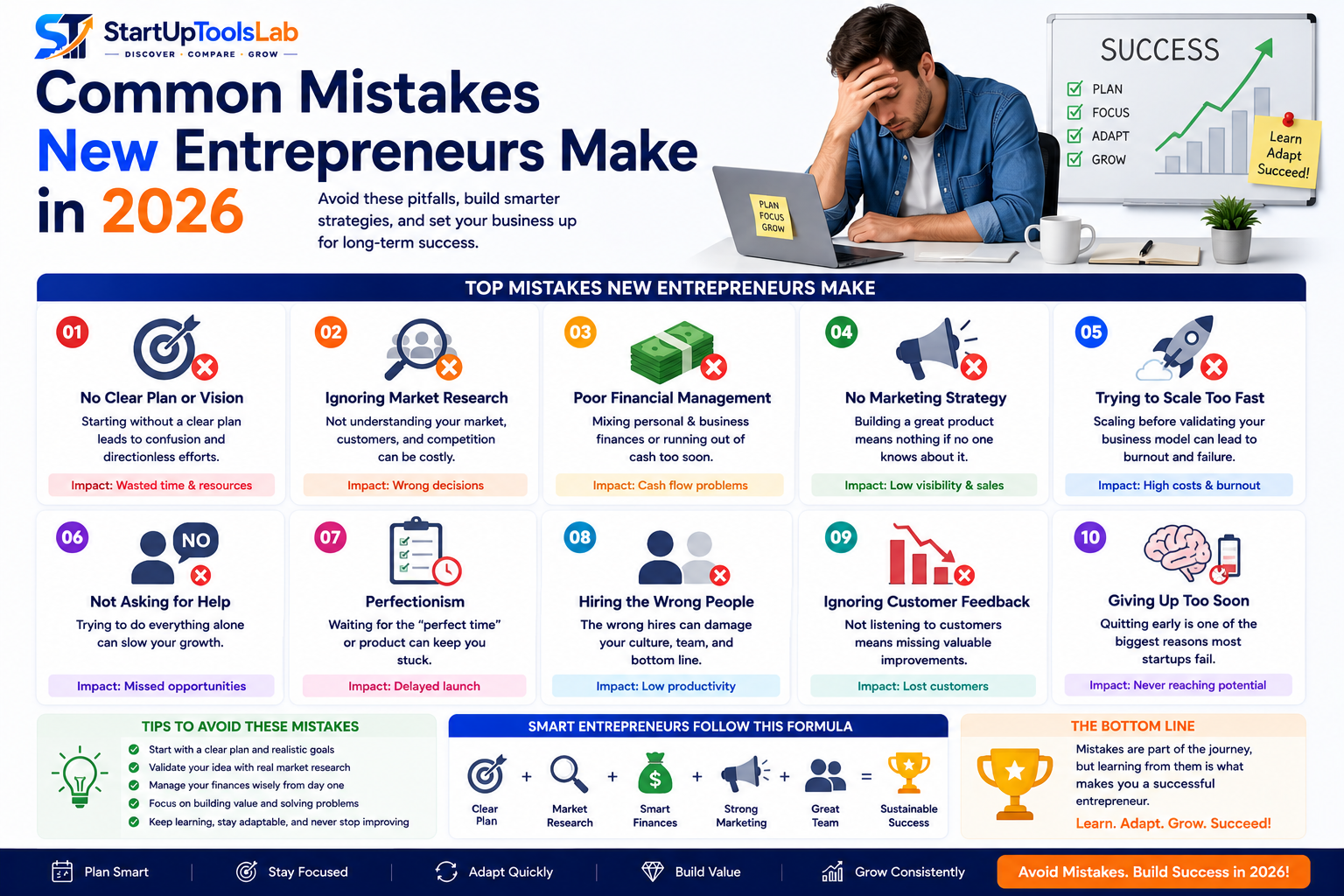
Common Mistakes New Entrepreneurs Make in 2026
Starting a business is exciting.
The idea of building something from scratch, becoming financially independent, and creating your own success motivates millions of people to become entrepreneurs every year.
But entrepreneurship is also challenging.
Many new business owners enter the market with great ideas but struggle because they make avoidable mistakes early in the journey. In most cases, businesses don’t fail because the founder lacked passion — they fail because of poor planning, weak systems, financial mistakes, inconsistent marketing, or unrealistic expectations.
The good news is that most entrepreneurial mistakes are preventable.
By learning from common startup mistakes early, entrepreneurs can save time, money, stress, and improve their chances of building a successful business.
In this guide, we’ll cover the most common mistakes new entrepreneurs make in 2026 and explain how to avoid them.
Why Most New Businesses Struggle
Many entrepreneurs start businesses with motivation but without systems or strategy.
Common challenges include:
- Poor financial management
- Weak marketing
- Lack of research
- Burnout
- Inconsistent execution
- Trying to scale too fast
The businesses that survive long-term are usually the ones that focus on:
- Systems
- Patience
- Consistency
- Financial discipline
- Customer value
Entrepreneurship is less about quick success and more about long-term execution.
1. Starting Without Market Research
One of the biggest mistakes entrepreneurs make is launching businesses based purely on personal excitement instead of actual market demand.
Just because you think an idea is good doesn’t automatically mean customers will pay for it.
Why Market Research Matters
Good market research helps businesses:
- Understand customer needs
- Analyze competitors
- Validate demand
- Identify pricing opportunities
- Reduce business risks
Questions Entrepreneurs Should Ask
- Is there real demand for this product or service?
- Who are the competitors?
- What problem does the business solve?
- Why would customers choose this business?
Helpful Research Tools
Google Trends
Helps identify trending industries and search demand.
Semrush
Useful for competitor research and keyword analysis.
2. Trying to Do Everything Alone
Many entrepreneurs avoid asking for help because they want complete control or want to save money.
But trying to handle:
- Marketing
- Customer support
- Accounting
- Design
- Operations
- Content creation
- Sales
all at once eventually leads to burnout.
Better Approach
Focus on your strengths and gradually delegate or automate repetitive work.
Helpful Productivity Tools
ClickUp
Notion
Zapier
Automation and organization help entrepreneurs scale more efficiently.
3. Ignoring Financial Management
Many startups fail because they don’t properly manage money.
Entrepreneurs often focus heavily on revenue while ignoring:
- Expenses
- Cash flow
- Taxes
- Profit margins
- Budgeting
Common Financial Mistakes
- Mixing personal and business finances
- Overspending early
- Ignoring bookkeeping
- Not saving for taxes
- Poor pricing strategies
Helpful Accounting Tools
QuickBooks
Xero
Wave
Good financial habits create stronger businesses.
4. Expecting Fast Results
Many entrepreneurs underestimate how long business growth actually takes.
Social media often creates unrealistic expectations about “overnight success,” but most successful businesses grow slowly through:
- Consistency
- Iteration
- Marketing
- Customer trust
- Systems
Reality of Entrepreneurship
Most businesses require:
- Months of testing
- Continuous learning
- Marketing adjustments
- Patience
Businesses that survive difficult early stages usually become stronger long-term.
5. Neglecting Marketing
Some entrepreneurs believe a good product will automatically attract customers.
Unfortunately, even excellent businesses fail without proper marketing.
Important Marketing Channels
- SEO
- Social media
- Email marketing
- Content marketing
- Paid advertising
- Networking
Helpful Marketing Tools
Canva
Mailchimp
Buffer
Semrush
Consistent marketing creates long-term visibility and growth.
6. Choosing the Wrong Business Partners
Partnerships can accelerate growth — or completely damage a business.
Many entrepreneurs rush into partnerships without discussing:
- Roles
- Responsibilities
- Equity
- Decision-making
- Financial expectations
Before Choosing a Partner
Make sure:
- Goals align
- Communication is strong
- Work ethic matches
- Responsibilities are clearly defined
Strong partnerships require trust and clarity.
7. Poor Time Management
Entrepreneurs often stay busy all day but still make little progress because they focus on low-impact tasks.
Common Productivity Problems
- Constant multitasking
- Lack of prioritization
- Poor scheduling
- Excessive meetings
- Social media distractions
Helpful Productivity Tools
Notion
ClickUp
Trello
Effective entrepreneurs focus on high-impact tasks first.
8. Ignoring Customer Feedback
Businesses grow faster when they listen to customers.
Some entrepreneurs become emotionally attached to their ideas and ignore feedback that could improve the business.
Why Feedback Matters
Customers help businesses:
- Improve products
- Fix problems
- Understand pain points
- Improve user experience
The best businesses evolve continuously based on customer needs.
9. Overspending on Tools and Branding Too Early
Many entrepreneurs spend too much money early on:
- Expensive logos
- Office spaces
- Premium software
- Unnecessary subscriptions
Better Strategy
Start lean and focus on:
- Product quality
- Marketing
- Customer acquisition
- Revenue generation
Businesses should invest strategically as they grow.
10. Not Building Systems Early
Businesses become difficult to scale when everything depends entirely on the founder.
Important Systems Entrepreneurs Need
- Marketing workflows
- Customer management
- Financial tracking
- Task management
- Automation processes
Helpful Business Systems Tools
HubSpot
Asana
Slack
Strong systems reduce chaos during growth.
11. Trying Too Many Business Ideas at Once
Many entrepreneurs constantly switch between:
- New ideas
- New business models
- New marketing strategies
This creates a distraction and prevents momentum.
Better Approach
Focus on:
- One strong business
- One main growth channel
- Consistent execution
Most successful businesses grow because of focus, not constant pivots.
12. Ignoring SEO and Long-Term Marketing
Many businesses focus only on short-term sales and ignore long-term traffic strategies.
SEO helps businesses:
- Generate organic traffic
- Reduce advertising costs
- Build authority
- Create sustainable growth
Helpful SEO Tools
Ahrefs
Semrush
Surfer SEO
Long-term marketing compounds over time.
13. Fear of Failure and Perfectionism
Many entrepreneurs delay launching because they want everything to feel perfect first.
But perfectionism often becomes procrastination.
Important Mindset Shift
Businesses improve through:
- Testing
- Feedback
- Iteration
- Real-world experience
Progress matters more than perfection.
Future of Entrepreneurship in 2026
Modern entrepreneurship is changing rapidly because of:
- AI automation
- Remote work
- Creator economy growth
- Ecommerce expansion
- SaaS platforms
- Digital marketing tools
Entrepreneurs who adapt quickly, learn continuously, and build systems strategically will have the strongest long-term advantages.
Final Thoughts
Every entrepreneur makes mistakes — that’s part of the journey.
The goal isn’t to avoid every failure perfectly. The goal is to:
- Learn faster
- Build smarter systems
- Stay consistent
- Improve continuously
The most successful entrepreneurs in 2026 are not necessarily the smartest or most talented. They’re often the ones who:
- Stay disciplined
- Focus long-term
- Adapt quickly
- Build strong systems
- Continue learning
Entrepreneurship rewards patience, execution, and consistency far more than perfection.