
Best Payroll Software for Small Teams in 2026
Managing payroll is one of the most important responsibilities for any business with employees.
Even small teams need accurate salary calculations, tax management, employee payments, compliance tracking, and payroll reporting. But handling payroll manually can quickly become stressful, time-consuming, and prone to costly mistakes.
That’s why businesses now rely on payroll software to automate salary processing, manage taxes, organize employee records, and simplify financial operations.
In 2026, payroll software has evolved significantly with AI-powered automation, cloud-based systems, employee self-service portals, automated tax filing, and HR integrations that make payroll management easier than ever.
Whether you run a startup, agency, ecommerce business, or remote team, choosing the right payroll software can save time, reduce errors, and improve employee satisfaction.
In this guide, we’ll cover the best payroll software for small teams in 2026 and help you choose the right platform based on your business size and payroll needs.
Why Small Teams Need Payroll Software
Many businesses initially process salaries manually through spreadsheets or bank transfers.
But as teams grow, manual payroll management often leads to:
- Salary calculation mistakes
- Tax filing errors
- Missed payments
- Compliance issues
- Time-consuming administration
- Poor employee experience
Payroll software helps businesses:
- Automate salary calculations
- Manage taxes and deductions
- Track employee payments
- Generate payroll reports
- Handle compliance requirements
- Reduce administrative workload
Using payroll systems early creates stronger operational efficiency and scalability.
What Makes Good Payroll Software?
Before choosing a payroll platform, businesses should understand which features matter most.
Important Features to Look For
Automated Payroll Processing
Automation reduces manual calculations and payment errors.
Tax Filing and Compliance
Good payroll tools simplify tax deductions and legal compliance.
Employee Self-Service
Employees should be able to access payslips, tax documents, and payroll history easily.
Integrations
The best payroll systems connect with accounting and HR software.
Cloud Accessibility
Cloud-based payroll systems support remote teams and flexible management.
Reporting and Analytics
Payroll reports help businesses manage labor costs and financial planning.
Scalability
The software should support future hiring and business growth.
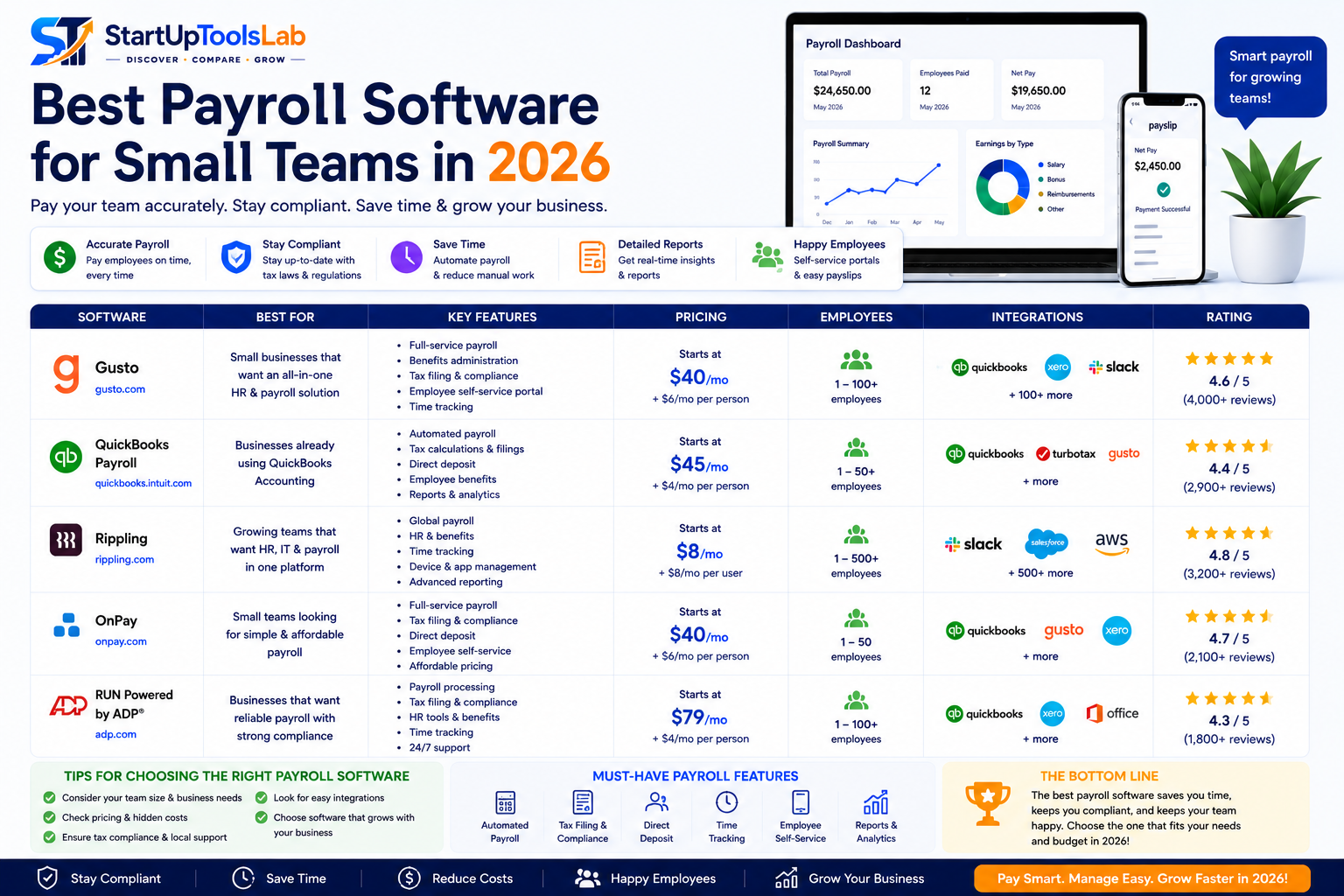
1. Gusto
Gusto is one of the most popular payroll solutions for small businesses and startups.
It combines payroll, HR management, benefits administration, and employee onboarding into one easy-to-use platform.
Key Features
- Automated payroll processing
- Tax filing
- Employee benefits management
- Time tracking
- Direct deposits
- Employee self-service portal
Why Small Businesses Love Gusto
Gusto simplifies payroll significantly while maintaining a clean and beginner-friendly interface.
It’s especially useful for startups and growing remote teams.
Best For
- Small businesses
- Startups
- Agencies
- Remote teams
2. QuickBooks Payroll
QuickBooks Payroll integrates directly with QuickBooks accounting software.
Main Features
- Automated payroll
- Tax calculations
- Direct deposits
- Payroll reporting
- Employee management
- Accounting integration
Why Businesses Choose It
Businesses already using QuickBooks often prefer QuickBooks Payroll because of seamless financial integration.
Best For
- Small businesses
- E-commerce brands
- Businesses using QuickBooks accounting
3. ADP
ADP is one of the largest and most trusted payroll providers globally.
Key Features
- Payroll automation
- Tax management
- HR support
- Compliance tracking
- Employee benefits
- Workforce management
Why It’s Popular
ADP offers strong scalability and enterprise-grade payroll capabilities.
Best For
- Growing businesses
- Medium-sized teams
- Businesses planning rapid expansion
4. Paychex
Paychex provides payroll processing along with HR and employee management tools.
Features Include
- Payroll automation
- Tax administration
- HR support
- Retirement services
- Employee onboarding
Why Small Teams Use Paychex
Its flexibility and customer support make payroll management easier for non-technical business owners.
Best For
- Small businesses
- Service companies
- Local businesses
5. Rippling
Rippling combines payroll, HR, IT management, and employee administration into one modern platform.
Main Features
- Payroll automation
- Device management
- Employee onboarding
- HR workflows
- App management
Why It Stands Out
Rippling centralizes multiple business operations beyond payroll alone.
Best For
- Tech startups
- Remote companies
- Scaling businesses
6. Deel
Deel specializes in global payroll and international team management.
Best Features
- International payroll
- Contractor payments
- Compliance management
- Multi-currency support
- Global hiring tools
Why Remote Businesses Prefer Deel
It simplifies payroll for international employees and freelancers.
Best For
- Remote teams
- Global startups
- International businesses
7. OnPay
OnPay is a budget-friendly payroll solution for small businesses.
Key Features
- Payroll automation
- Tax filing
- HR support
- Employee onboarding
- Benefits management
Why Businesses Like It
OnPay provides strong payroll functionality at affordable pricing.
Best For
- Small businesses
- Startups
- Budget-conscious companies
8. BambooHR
Although primarily an HR platform, BambooHR includes payroll and employee management features.
Main Features
- Payroll management
- Employee records
- Performance tracking
- Hiring workflows
- HR reporting
Why Businesses Use BambooHR
It works well for companies needing both HR and payroll management together.
Best For
- Growing teams
- HR-focused businesses
- Service companies
How to Choose the Right Payroll Software
Not every business needs enterprise-level payroll systems.
The best payroll software depends on:
- Team size
- Budget
- Country-specific tax requirements
- Remote work structure
- HR needs
- Future growth plans
Best Payroll Software by Business Type
Best Overall Payroll Software
Gusto
Best for Accounting Integration
QuickBooks Payroll
Best for Global Teams
Deel
Best for HR and Payroll Together
Rippling
Best Enterprise Payroll Platform
ADP
Best Budget-Friendly Payroll Tool
OnPay
Common Payroll Mistakes Small Businesses Make
Many businesses struggle with payroll because of poor systems and manual processes.
Common Mistakes Include:
- Missing payroll deadlines
- Incorrect tax calculations
- Poor employee record management
- Delayed reimbursements
- Non-compliance with tax regulations
- Mixing payroll with manual bookkeeping
Payroll software helps businesses reduce these risks significantly.
Future of Payroll Software in 2026
Payroll systems are rapidly evolving with AI-powered automation and workforce analytics.
Modern payroll platforms now offer:
- AI payroll processing
- Automated compliance monitoring
- Smart tax calculations
- Predictive workforce analytics
- Automated onboarding
- Real-time payroll reporting
Businesses adopting automation early can reduce administrative workload while improving payroll accuracy and employee experience.
Final Thoughts
Payroll software has become essential for businesses managing even small teams.
The right payroll platform helps businesses automate salary processing, manage taxes efficiently, reduce errors, improve compliance, and save valuable administrative time.
Whether you’re a startup founder, agency owner, ecommerce business, or remote team manager, investing in reliable payroll software can simplify operations and support long-term growth.
In 2026, businesses using automated payroll systems and cloud-based workforce management tools will have a major advantage in operational efficiency and scalability.