
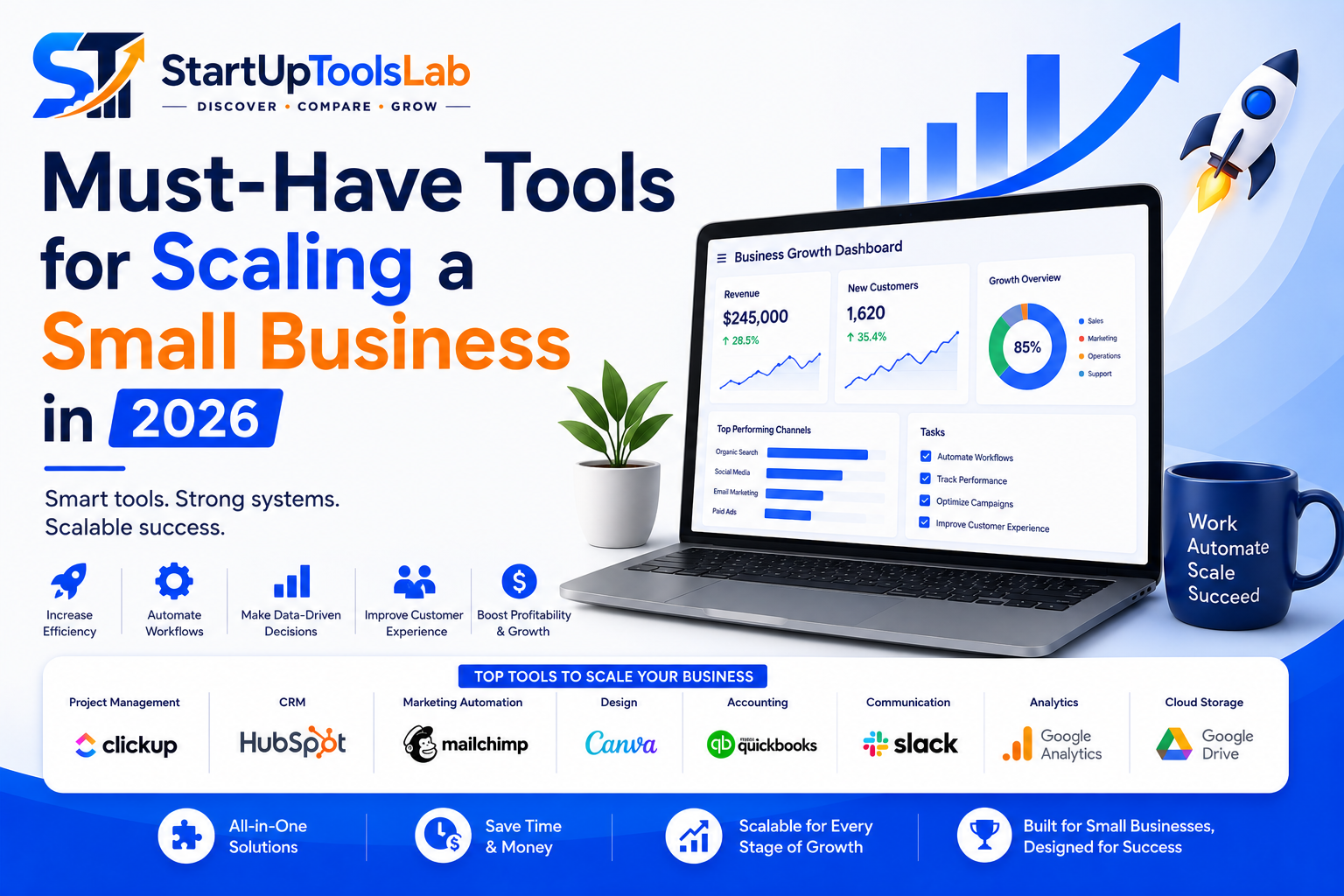
Must-Have Tools for Scaling a Small Business in 2026
Starting a small business is challenging. Scaling it successfully is even harder.
As your business grows, so do your daily operations, customer demands, team responsibilities, and management challenges. Without the right systems in place, growth can quickly become overwhelming.
That’s why successful businesses rely heavily on modern SaaS tools.
The right business software helps automate repetitive tasks, improve team productivity, organize workflows, manage customers efficiently, and support long-term growth without requiring massive operational costs.
In this guide, we’ll cover the must-have tools for scaling a small business in 2026 and explain how they can help businesses grow smarter, faster, and more efficiently.
Why Small Businesses Need Scalable Tools
Many small businesses initially rely on manual work, spreadsheets, and disconnected systems.
While that may work in the beginning, scaling becomes difficult when:
- Customer numbers increase
- Teams grow larger
- Workflows become more complex
- Communication slows down
- Operations become disorganized
Scalable business tools solve these problems by improving efficiency and automation.
Benefits of Using SaaS Tools for Scaling
- Increased productivity
- Faster operations
- Better customer management
- Improved collaboration
- Reduced manual work
- Lower operational costs
- Stronger business organization
Businesses that invest in systems early often scale much faster than those relying only on manual processes.
1. Project Management Tools
As teams grow, managing projects manually becomes nearly impossible.
Project management software helps businesses organize workflows, assign tasks, track deadlines, and improve accountability.
ClickUp
ClickUp is one of the best all-in-one tools for scaling businesses.
Key Features:
- Task management
- Workflow automation
- Time tracking
- Team collaboration
- Goal tracking
- AI-powered productivity tools
It’s especially useful for businesses handling multiple projects and remote teams.
Asana
Asana is ideal for structured workflow management and growing operational teams.
Best For:
- Marketing teams
- Agencies
- Product development
- Medium-sized businesses
Its visual timelines and organized task system make scaling smoother.
Monday.com
Monday.com offers highly visual dashboards and workflow customization.
Why Businesses Use It:
- Workflow tracking
- Team coordination
- Automation
- Performance dashboards
It’s excellent for businesses managing multiple departments and operations simultaneously.
2. CRM Tools for Customer Management
As customer numbers increase, businesses need systems to manage leads, communication, and sales pipelines efficiently.
HubSpot
HubSpot is one of the most popular CRM platforms for growing businesses.
Features Include:
- Contact management
- Email tracking
- Lead management
- Sales pipelines
- Marketing automation
HubSpot helps businesses centralize customer operations and improve conversion rates.
Zoho CRM
Zoho CRM offers advanced customization and automation features at affordable pricing.
Best For:
- Startups
- Small businesses
- Growing sales teams
Its scalability makes it a strong choice for businesses planning long-term expansion.
3. Accounting and Financial Tools
Scaling businesses need proper financial visibility and automation.
Modern accounting software simplifies bookkeeping, payroll, invoicing, tax management, and expense tracking.
QuickBooks
QuickBooks remains one of the best accounting tools for scaling small businesses.
Key Features:
- Automated bookkeeping
- Payroll management
- Financial reporting
- Tax preparation
- Cash flow tracking
It’s particularly useful for ecommerce brands, SaaS startups, and service businesses.
Xero
Xero is known for its modern interface and strong cloud collaboration features.
Why Businesses Choose Xero:
- Unlimited users
- Real-time financial tracking
- Remote accessibility
- Multi-currency support
It’s ideal for businesses with distributed teams and remote financial management.
FreshBooks
FreshBooks is excellent for freelancers, consultants, and service-based businesses.
Best Features:
- Simple invoicing
- Expense tracking
- Client management
- User-friendly dashboard
4. Marketing Automation Tools
Marketing becomes harder to manage manually as businesses grow.
Marketing automation platforms help businesses streamline campaigns, lead generation, customer engagement, and analytics.
Mailchimp
Mailchimp is widely used for email marketing automation and audience engagement.
Features Include:
- Email campaigns
- Customer segmentation
- Analytics
- Automation workflows
It’s beginner-friendly and effective for growing businesses.
Semrush
Semrush helps businesses improve online visibility through SEO and digital marketing insights.
Best Uses:
- Keyword research
- Competitor analysis
- SEO audits
- Backlink monitoring
- Content optimization
Businesses investing in SEO early often generate long-term organic traffic and lower marketing costs.
Canva
Canva allows businesses to create professional marketing content without hiring large design teams.
What Businesses Create:
- Social media graphics
- Presentations
- Advertisements
- Marketing materials
- Videos
It’s one of the most useful content creation tools for small businesses.
5. Communication and Collaboration Tools
Scaling businesses require faster and more organized communication systems.
Slack
Slack remains one of the best communication tools for startups and growing teams.
Main Benefits:
- Instant messaging
- Team channels
- Workflow integrations
- File sharing
- AI-powered conversation summaries
It significantly improves team collaboration and internal communication.
Microsoft Teams
Microsoft Teams is ideal for businesses already using Microsoft 365 products.
Best Features:
- Video meetings
- File collaboration
- Team communication
- Office integrations
Zoom
Zoom remains one of the most reliable platforms for virtual meetings, webinars, and client communication.
6. Productivity and Knowledge Management Tools
As businesses scale, internal organization becomes increasingly important.
Notion
Notion combines note-taking, databases, project management, and documentation into one platform.
Businesses Use Notion For:
- SOP documentation
- Team wikis
- Business planning
- Content calendars
- Knowledge management
It’s highly flexible and scalable for growing teams.
Google Drive
Google Drive helps businesses manage files, collaborate in real time, and securely store important documents.
Key Advantages:
- Cloud storage
- Team collaboration
- Real-time editing
- Easy file sharing
7. AI Tools for Business Automation
AI-powered software is transforming how businesses operate in 2026.
OpenAI ChatGPT
ChatGPT helps businesses automate:
- Content writing
- Customer support
- Brainstorming
- Research
- Email drafting
- Marketing assistance
AI tools save businesses countless hours and improve operational efficiency.
How to Choose the Right Scaling Tools
Not every business needs every tool.
Before investing in software, businesses should evaluate:
Scalability
Choose tools that can support future business growth.
Ease of Use
Complicated systems reduce team adoption and productivity.
Integrations
Your software stack should work together smoothly.
Pricing
Avoid overspending on features your business doesn’t need yet.
Customer Support
Reliable support becomes critical during scaling phases.
Common Mistakes Small Businesses Make
Many businesses adopt too many tools too quickly.
This often leads to:
- Software overload
- Team confusion
- Duplicate systems
- Workflow inefficiencies
Instead, businesses should focus on building a streamlined software ecosystem with:
- One CRM
- One communication platform
- One project management system
- One accounting solution
Simplicity improves scalability.
Final Thoughts
Scaling a small business requires more than hard work — it requires systems, automation, and efficient workflows.
The right SaaS tools help businesses improve productivity, automate operations, manage customers effectively, and scale sustainably without dramatically increasing operational costs.
From project management and CRM software to accounting platforms, communication tools, marketing automation, and AI-powered productivity solutions, modern business software gives small businesses the ability to compete at a much higher level.
In 2026, businesses that embrace scalable tools early will grow faster, operate more efficiently, and build stronger foundations for long-term success.